❌ An Account-Based GTM Strategy; Not Just a “Marketing Campaign”
ABM ≠ just paid ads.
ABM ≠ a siloed marketing campaign or group of tactics.
ABM ≠ using 3rd party intent data to build lists of “in-market” accounts.
The “M” in Account-Based Marketing can be wildly misleading and is outdated verbiage.
This is due to the fact that it’s not JUST a marketing strategy, you are actually building a complete Account-Based GTM strategy that unifies and involves all revenue teams. Which takes a village in order to drive a successful implementation and execution, hence why it’s imperative to properly establish your cross-functional ecosystem on day 1.
Account-Based GTM: A holistic go-to-market (GTM) strategy that unifies a company's revenue teams to collaboratively increase engagement and drive revenue growth in specific target accounts.
ForgeX Research
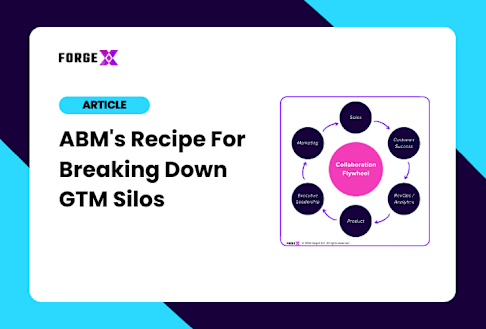
🛞 Leveraging Our Collaboration Flywheel
 Source: ForgeX Research Library
There are typically 6 core GTM teams that will make up your cross-functional ecosystem:
Cross-functional Team
Roles
Marketing
Product
Creative / Design
Content
Demand Generation / Field
Events
Digital
*Partner
*Sales Enablement
Sales
VP
Director
Account Executive (AE)
Sales Development Representative (SDR)
Solutions Consultant (SC)
*Partner
*Sales Enablement
Customer Success
Customer Success Manager (CSM)
*Partner
RevOps / Analytics
Marketing Data & Analytics
Sales Ops
Marketing Ops
GTM / RevOps
Product
VP of Product
Director of Product
Product Owner
Product Manager
Executive Leadership
CMO
CEO
CFO
CRO
Keep in mind that a <$20 Million ARR organization’s Collaboration Flywheel will be a lot different than a >$1 Billion ARR organization’s.
The core difference is the size and depth of each cross-functional team. Larger organizations are far more complex with bigger internal team sizes and external partners (like agencies).
Ensuring that you’re mapping and including all essential cross-functional team partners at the beginning of your program is a make-or-break.
🤝 How to Create Strong Partnerships Across Cross-functional Teams
In order to create strong cross functional partnerships, there are 5 areas that we recommend you focus on:
1.) Mutually Agreed SLAs:
Establish and define clear Service Level Agreements (SLAs) across all GTM teams to set expectations for delivery and follow-up on action items and deliverables. An Account-Based Team Charter can serve as a foundational document, articulating these SLAs where everyone agrees and signs off before the program kicks off.
Example:
- SLA; The Creative Team will build a new tailored ABM landing page within 5-days of the request.
Account-Based Team Charter: A mutual agreement across GTM teams that establishes a cadence and rigor around SLAs, roles, responsibilities, and what the program will entail from both an operational and strategic perspective.
ForgeX Research
2.) Roles are Clearly Established:
Without clearly defined roles, cross-functional teams won’t know how to collaborate or what their responsibilities are. It’s imperative that each team understands their role and how it contributes to the overall vision and revenue-driving impact of their work. Using a R.A.C.I matrix can be a great tool to help establish roles and responsibilities.
R.A.C.I.: A model that assigns roles and responsibilities across cross-functional teams to ensure clear task ownership and efficient communication.
~ Responsible (those who do the work).
~ Accountable (the one ultimately answerable).
~ Consulted (those whose opinions are sought).
~ Informed (those kept up-to-date on progress).
ForgeX Research
3.) Internal Communication Strategy:
Developing a robust internal communication strategy and feedback loop is essential. Continuous alignment, feedback, and recognition of team contributions are critical for maintaining morale and ensuring everyone is informed about the successes and impact of their efforts.
We share how to do this effectively here.
4.) Expectations are Properly Set:
It’s imperative to set realistic expectations for your program. While quick wins are essential, overpromising massive revenue increases in a short time period can harm morale and reduce enthusiasm for collaboration.
5.) Establishing a Common Account-Based Vision:
Without a shared vision, it’s challenging for cross-functional teams to buy-in and see the direction of GTM efforts. Start with a Crawl, Walk, Run approach to set the stage for the main north star while outlining smaller, achievable steps to reach that goal.

💡 Pro Tip: Don’t try and boil the ocean… Leveraging a crawl, walk, run approach will help set realistic expectations and pave a practical path for your account-based GTM strategy. Attempting to immediately reach the run stage can lead to setbacks and frustration.