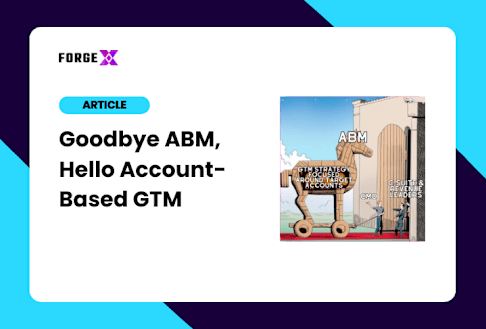
🛩️ ABM Has Left the “Pilot” Stage
This isn’t a headline we expected to be writing until at LEAST 2026.
But alas, here we are…
💡 Emerging Trend: While launching an account-based motion for the first time, organizations are ditching the small-scale ABM pilot in favor of a full Account-Based GTM implementation across all revenue teams.
We’ve uncovered this through our on-going ABM Benchmark Audits of organizations from ranging from $5 million to +$20 billion in ARR.
 ABM → Account-Based GTM
❌ The OLD Way: Small Pilot Program
Initiate of the Implementation: VP of Marketing / Director of Demand Generation
Initial Program size: Small, labeled as a “Pilot” ABM program.
ABM Type: Either Enterprise ABM 1:Few (<25 accounts or less in a cluster) or a small batch of Growth ABM (50s or 100s).
Overview:
ABM is seen as an innovative approach. Although widely adopted, it’s still viewed as an experimental marketing-led motion.
Either a dedicated ABM practitioner, or existing demand generation team member is responsible for the implementation of an “ABM Pilot”.
This includes a small batch of accounts, accompanied by a few sales partners. There isn’t a broad implementation and it’s kept intentionally small to prove out the motions effectiveness.
✅ The NEW Way: Org-wide Implementation
Initiate of the Implementation: C-suite (CEO, CMO, CRO).
Initial Program size: Fully integrated, organization-wide implementation of an Account-Based GTM motion.
ABM Type: Growth ABM is mainly applied first given that it’s infrastructure is native to scaled coverage.
Overview:
The C-suite holds an underlying sense of FOMO given the fact that their peers are realizing success with mature Account-Based GTM motions.
They either internally promote or externally hire an individual to oversee the org-wide implementation of an Account-Based GTM motion spanning across all revenue teams.
This is seen as a transformational and cultural shift, as ALL revenue teams are now aligned on a list of target accounts and modernized account-based metrics that actually drive alignment and cohesion.
💪 5 Reasons Why This Just Makes Sense
- Sales has already been account-based for YEARS… the other GTM teams are just catching up.
- Entire GTM is unified around an agreed target account list, fostering strategic clarity and resource efficiency.
- Marketing, sales and customer success rally together to achieve unified account-based metrics; it’s not function Vs. function anymore.
- Focus on identifying and engaging the buying group as a GTM team, marketing isn’t just “throwing MQLs” at the sales team.
- Teams leverage the Growth ABM and Enterprise ABM architectures to build a holistic account-based motion.
🤔 Rethinking the “ABM” Title
With this NEW way, comes new titles.
At this point, we can all agree that labelling your program as ‘Account-Based Marketing’ is wildly misleading.
It’s not just some marketing campaign or tactic, it’s a full-scale GTM motion.
As we continue to see the trend of org-wide implementations, this is also being accompanied by a new title / role.
We’re seeing the emergence of the “Account-Based GTM” title in real-time.
Here are TWO examples from organizations that are drastically different in size who have implemented this within the last 12-months.
1. Example: $1.3 Billion ARR Company

2. Example: $33.3 Million ARR Company

ALL of the above is why we’ve gone all-in on Account-Based GTM at ForgeX.
It’s the underlying architecture that every B2B revenue team will, and should be using.