🚩 10 Warning Signs Your ABM + Sales Partnership is in Trouble
If you’ve been in the ABM space for a while, working with a challenging sales partner can be an inevitable part of the process.
Here are the top 10 warning signs to look out for:
- Misaligned Sales Incentives = Your BDR / SDR team gets paid more for “sales-sourced” qualified leads and opportunities.
- Sales STILL Doesn’t Understand ABM = It’s been +6 months and your sales team can’t define ABM and how it differs from other internal marketing initiatives.
- Lack of Consistent Data Hygiene = Sales teams aren’t logging activities or associating buying group members to open opportunities.
- Missing ABM / Sales Meetings = Sales teams continue to push out dedicated ABM meetings or just don’t show up.
- Withholding Timely Account Updates = The ABM team isn’t seen as “a strategic part of the account team” and timely updates aren’t shared.
- Not Actioning Within Agreed SLAs = Your sales partners aren’t actioning their part of the campaign plan within the SLAs set at the beginning of the program.
- ABM is STILL Seen as a Lead Generation Motion = A continued legacy mindset that ABM isn’t a holistic GTM motion, and only exists to pass over “MQLs”.
- Slow “Quick-wins” = The ABMer doesn’t prioritize quick-wins at the beginning of the program and only looks towards the long-term.
- Target Account Lists are a Revolving Door = Sales leadership views the target account lists as an open ‘revolving door’ where they can move accounts in and out every week.
- Unreasonably Set Expectations = The ABMer has set unrealistic expectations of timelines and depth of tactical personalization.
🤝 How to Drive a Strong Partnership
We have been silently conducting ABM Benchmark Audits of leading programs ranging from $5M to $20B ARR as we build out our Benchmarking Database.
(🤫… this hasn’t officially launched yet!)
Through our audits, here are the top 5 best practices we have uncovered:
- Enablement Doesn’t Stop After Week 1 = It requires constant enablement to implement a successful account-based GTM. This is from the CEO to BDR.
- Understand Sales’ Success Metrics = You should understand what explicit incentives your sales teams have, and consider how to align these with ABM program goals.
- Add “Account-Owner Fit” to the TAL Weighting Criteria = While choosing your target accounts, think about whether the sales person will be a good partner. Individuals who will be a strong internal champion and share wins across the team should also be weighted higher.
- Build a Strong VP / Director of Sales Relationship = It’s imperative to build a strong relationship with the sales leader. If all else fails, they can help act as an advocate if you’re having challenges with an AE / BDR.
- Be Prepared - Do Your Homework = Constantly keeping up-to-date with changes to your org’s GTM motion and staying on the pulse of your target accounts. The sales team will take note of this while you meet.
Bonus
- Aim for Quick-wins = It can take time to properly set up your ABM program, but this doesn’t mean everything has to be SLOW. Make sure to prioritize early wins to drive momentum and buy-in.
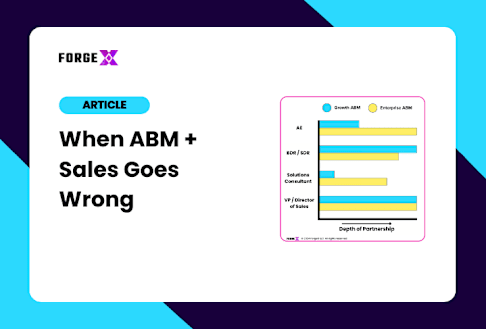
👀 How Sales Partnerships Differ Across Growth ABM and Enterprise ABM
Not all partnerships with sales look alike…
Especially when it comes to the underlying ABM framework that you’re running; Growth ABM or Enterprise ABM.
The depth of the partnership and involvement of each sales team might look very different.
(WARNING: In order to get the most out of the below, it’s critical to understand the differences between Enterprise ABM & Growth ABM - read this.)
 Growth ABM vs. Enterprise ABM
Growth ABM
- AE (Account Executive) = Due to a higher volume of account coverage and (typically) a focus on generating net-new pipeline, direct involvement of the AEs is less than the BDR / SDRs.
- BDR / SDR (Business Development Rep) = The primary sales partner who is actioning the campaign tactics.
- Solutions Consultant = Very little, sometimes no involvement.
- VP / Director of Sales = A strong partnership is critical.
Enterprise ABM
- AE = The ABMer partners directly with the AE’s and should be seen as a strategic teammate.
- BDR / SDR = Although heavily involved, the AE’s are your primary partner.
- Solutions Consultant = As Enterprise ABM is mostly seen within expansion plays, the SC’s will have higher involvement.
- VP / Director of Sales = A strong partnership is critical.